
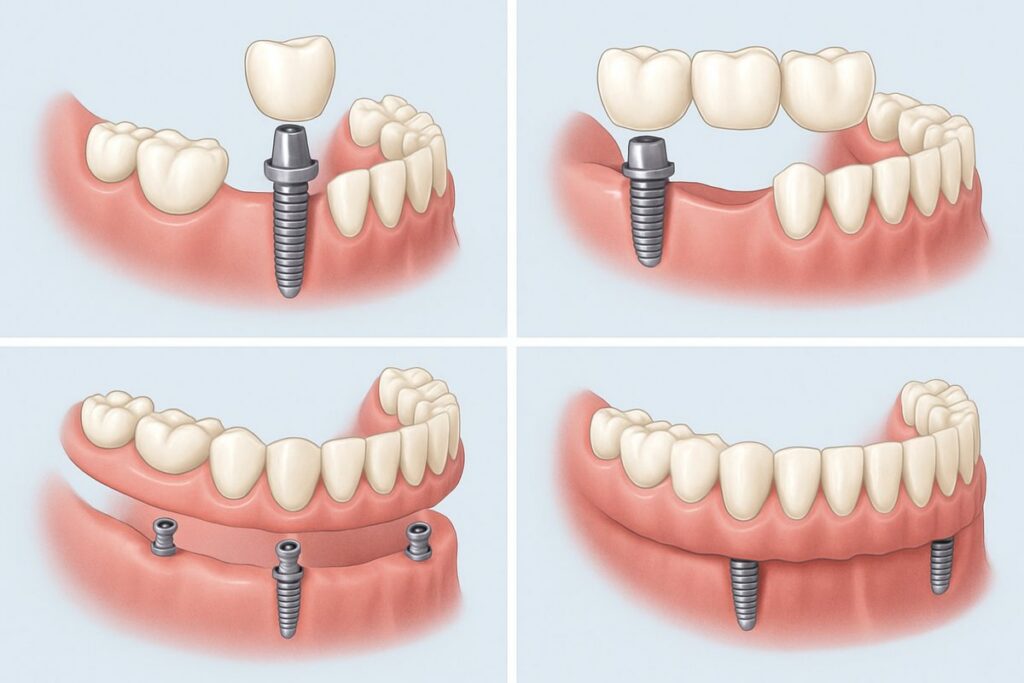
Choosing the right option for replacing missing teeth affects how you eat, speak, and smile. This guide covers the common types of teeth implants in Omaha, NE and explains which options fit different needs for function, appearance, and long-term oral health.
Quick primer: What is a dental implant?
A dental implant is a three-part system: a titanium or zirconia post (the root replacement) placed in the jaw, an abutment that connects the post to the visible piece, and the final restoration (crown, bridge, or denture). Implants replace tooth roots to provide stable support for restorations and protect bone and facial structure over time.
Main types of teeth implants
Single-tooth implants
A single implant replaces one missing tooth with one post, one abutment, and a crown. This is the most natural-feeling option for an isolated gap and preserves adjacent healthy teeth because it doesn’t require altering neighboring teeth.
Implant-supported bridge
When several adjacent teeth are missing, two or more implants can support a bridge. This restores multiple teeth without using natural teeth as anchors, improving durability and chewing efficiency versus a traditional bridge.
Implant-retained overdentures (removable)
A lower-cost option uses a few implants to snap a removable denture into place. Overdentures offer better retention and chewing than conventional dentures and are easier to clean because they can be removed daily.
Full-arch fixed solutions (All-on-4 / All-on-X)
Full-arch fixed prostheses use multiple implants to support a permanent bridge that replaces an entire upper or lower arch. These solutions can often be completed in fewer visits and restore function and appearance close to natural teeth.
Mini dental implants
Mini implants are narrow-diameter posts used in limited spaces or to stabilize dentures when bone volume is low. They can be placed with less invasive surgery and sometimes used as a quicker, temporary option.
Material options: titanium vs zirconia
Titanium is the long-standing standard for strength and bone integration. Zirconia offers a metal-free alternative for patients with metal sensitivities or who want a white implant for esthetics. Your surgeon will recommend the best material based on anatomy and needs.
Specialty implants (subperiosteal, zygomatic)
For severe bone loss or complex anatomy, specialty implants like subperiosteal or zygomatic implants provide alternative anchorage. These are less common and used when traditional implants aren’t feasible.
How to pick the right type for you
Key factors: number of missing teeth, bone volume, health, budget, and timeline
The number and location of missing teeth, available bone, overall health (e.g., diabetes, smoking), budget, and desired timeline guide the choice. Single implants suit one tooth; bridges work for several adjacent teeth; overdentures and full-arch solutions are best for many or all missing teeth.
Role of the surgical team vs your general dentist
Oral surgeons place implant posts and abutments with surgical precision. Your general dentist or prosthodontist completes the final restoration—matching shade, shape, and bite—so coordination between teams ensures the best outcome.
What to expect during implant treatment
Consultation and planning
Expect imaging like CBCT scans and digital impressions to map bone and nerves and to plan implant size and position. Good planning shortens surgery time and improves predictability.
Surgery, anesthesia, and recovery
Implant surgery can be done with local anesthesia, IV sedation, or general anesthesia. Surgeons use guides to place implants accurately. Post-op care includes pain control (often non-opioid options) and several months for healing and osseointegration.
Working with a surgical specialty practice
Midwest Oral Surgery & Dental Implants provides experienced oral surgeons who place posts and abutments using CBCT, surgical guides, zirconia options, and advanced anesthesia, then coordinate with your general dentist for the final restoration.
Questions to ask your surgeon and restorative dentist
Which implant type do you recommend and why? Who will handle the crown/bridge/denture? What materials will be used? What is the timeline and cost estimate? What are risks and alternatives?
Next steps
Schedule a surgical consult and coordinate with your general dentist to review images and treatment plans. With the right team and a clear plan, you can move forward confidently toward the best implant option for your mouth. Contact us today to start your journey.